
Twins Pirex glass circulator with 5 liter capacity
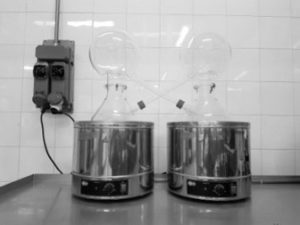 The circulator called “Gemini” owes its name to the perfect symmetry that characterizes it: to activate the circulation you need two identical distillers and two equivalent heat sources, mirroring like brothers born from the same principle. This duplicity is not a technical detail, but a symbolic sign: circulation is based on the harmony of opposites, on the balance between two forces that, although distinct, are reflected in each other.
The two heat sources can be turned on together, to give life to a more intense and complete motion, or individually, depending on the type of circulation that the alchemist intends to perform. It is the freedom of art: choosing which twin to awaken, which energy to activate, which rhythm to impart to the process.
Unlike the Pelican, where the shape recalls sacrifice and nutrition, in the “Gemini” the two distillers look into each other’s eyes, as in a silent and specular dialogue. The tube — the “nose” of the capital — of each penetrates the underneath, the “belly” of the other, creating an intimate and reciprocal bond. It is a gesture that belongs not only to mechanics, but to symbolism: an act of coniunctio, of deep union, where each vessel becomes both giver and receiver.
The “Gemini” is therefore not just a tool: it is the living representation of the duality that is recognized and integrated, of the circulation that arises from the encounter between two specular principles. It is the sign that the Alchemical Work is accomplished not in isolation, but in dialogue, in the fusion of opposites, in the dance of the twins who look at each other and penetrate each other, generating a new and indivisible substance.
In this type of circulator, consisting of two twin distillers, the distillate of one falls back on the matter contained in the other, and vice versa. A perpetual motion is thus generated, a reclined eight-shaped cycle, a perfect image of the symbol of infinity. It is not just a technical movement, but a real alchemical dance: two currents that chase and feed each other, without ever interrupting each other. The reclining eight then becomes the visible representation of an invisible principle: the continuity of transformation, the eternal return, the circulation that knows no end: depicted very well with the dragon or serpent biting its tail (Ouroboros[1]).
Every drop that passes from one distiller to another brings with it a fragment of life, a seed of regeneration. Matter, crossed by this infinite cycle, purifies and sublimates itself, until it becomes an indivisible unity. It is the sign that the Work is not accomplished in a single vessel, but in the meeting of two instruments that reflect and nourish each other, like two poles of the same principle.
The “Gemini” circulator thus becomes a living image of infinity: what falls rises, what separates is reunited, what is transformed returns to itself in an endless spiral. It is the law of alchemy made visible: time that bends, matter that renews itself, energy that circulates eternally.
Some short original aphorisms related to the text:
- “Gemini teaches that harmony is born from opposites that mirror each other.”
- “Two distinct forces look at each other and integrate, as brothers of the same principle.”
- “Symmetry is a sign of balance, not separation.”
- “Each vessel is both giver and receiver.”
- “The true Work is not accomplished in isolation, but in the dialogue of opposites.”
- “Coniconio is a profound union: fusion that generates indivisible substance.”
- “The reclined eight-piece cycle is a visible image of infinity.”
- “Gemini is a living image of eternal return.”
[1] The word Ouroboros derives from the ancient Greek οὐροβόρος (oura = tail, boros = to devour), and literally means “one who devours his own tail”. The symbol originates in ancient Egypt and was then taken up in the Greek-Hellenistic tradition.


