
Pyrex glass pelican with 2 liters capacity
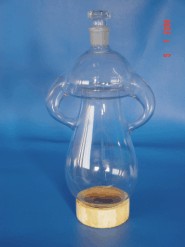
Let us now examine the Pelican, one of the oldest and most fascinating circulators of the alchemical tradition. Its particular conformation does not only respond to technical needs, but contains a profound symbolic meaning that over the centuries has made it one of the emblems of the Opera.
The name of this instrument derives from its characteristic shape, which recalls the figure of the pelican. Observing it from the side, the capital resembles the head of the animal, while the curved tube that descends from it to the central part of the vase evokes the beak facing one’s chest. Through this path, the liquid, after evaporating, condenses and falls incessantly inside the container, feeding a continuous cycle of circulation.
This image recalls the ancient iconography of the mystical pelican, depicted as it tears its chest to nourish its young with its blood, a universal symbol of sacrifice, regeneration and life that is renewed. So even in the alchemical vase the distillate constantly returns to the matter from which it comes, as if it were the very blood of the Work that feeds and regenerates its body.
From an operational point of view, the Pelican is used both in Spagyria (or Spagyria) and in Alchemy to maintain a continuous circulation of substances, favoring their maturation, purification and intimate union. The continuous succession of evaporation, condensation and fallout allows the principles to meet repeatedly, integrate more and more deeply and achieve a progressively more perfect balance.
One of the most significant examples is represented by the preparation of the Spagyric Quintessence described by Paracelsus, in which the Pelican is used to reunite the three Philosophical Principles — Mercury, Sulphur and Salt — so that, through continuous circulation, they can regain their original unity and give life to a fully completed remedy.
The Pelican is therefore not only a container intended for the circulation of matter, but an authentic symbol of Art. In it, the vase becomes a living body, the distillate is transformed into the blood that continually regenerates the Work, and technique is elevated to a philosophical language. Operational precision and symbolic depth thus merge in a single circulatory gesture, making the Pelican one of the most representative instruments of the spagyric and alchemical tradition.
The Pelican presented here is handcrafted in Pyrex glass, a material particularly suitable for the circulation operations required by spagyric and alchemical practice.
Some short original aphorisms related to the text:
- “The alchemical pelican is an emblem of sacrifice and regeneration.”
- “The vessel becomes body, the distillate becomes blood.”
- “The heart of the Work beats in the pelican’s chest.”
- “Form becomes symbol, technique is transfigured into myth.”
- “In the gesture of the pelican, the dual nature of Art is summed up.”


