
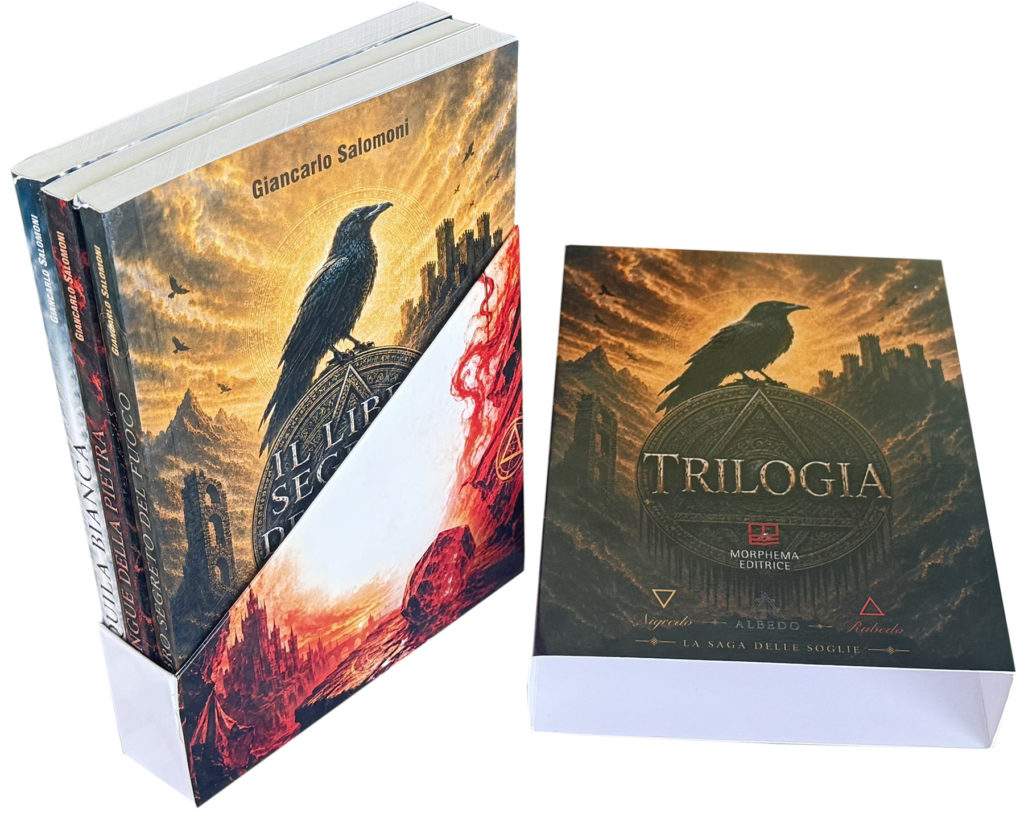
TRILOGY “THE SAGA OF THE THRESHOLDS”
Vol. 1: THE SECRET BOOK OF FIRE
Vol. 2: THE WHITE EAGLE
Vol. 3: THE BLOOD OF THE STONE
Author: Giancarlo Salomoni
Format 15×21 – Pages 624
Publisher: MORPHEMA EDITRICE
GIANCARLO SALOMONI – TRILOGY “THE SAGA OF THE THRESHOLDS”
THREE VOLUMES. THREE PHASES. THREE THRESHOLDS
A single great narrative work, in which the mystery of Alchemy becomes the very mystery of man.
An initiatory trilogy through Nigredo, Albedo and Rubedo
There are stories that are limited to being read. Others, on the other hand, seem to call the reader, slowly attract him beyond the boundary of the visible and lead him into territories in which every image hides a meaning, every encounter becomes a test and every word can open a threshold.
The Saga of the Thresholds belongs to this second kind of books.
Inspired by the three great phases of the Alchemical Work — Nigredo, Albedo and Rubedo — the trilogy develops a broad narrative, symbolic and initiatory journey, in which adventure is intertwined with mystery, the search for knowledge with inner confrontation, and the hermetic tradition with the deepest questions of the human being.
The three novels make up a single great work. Each volume has its own identity, its own atmosphere and its own inner movement, but all are united by the same thread: transformation. It is not only the transformation of matter sought by the ancient alchemists, but the more secret transformation that takes place in man when certainties are destroyed, the shadow emerges, consciousness is purified and what was dispersed finally manages to find a center.
At the heart of the trilogy opens an ancient and restless world, crossed by forgotten monasteries, buried libraries, crypts, hidden laboratories, secret brotherhoods, incomplete manuscripts and symbols handed down through the centuries. It is a universe in which the past has not really passed, but continues to live in the stones, books, names and oaths of those who have guarded Tradition.
Elia, Adrian, Marek, Leonie and the other characters of the saga are progressively involved in a search that exceeds all their initial understanding. What at first appears as an enigma to be solved or a secret to be found soon turns into a test capable of changing their destiny forever.
They move on the trail of an ancient, fragmented and hidden knowledge, of which only incomplete signs remain: a broken Emerald Tablet, a stone crossed by mysterious veins, a book kept in silence, a fire that continues to live under the ashes, a white light that does not yet coincide with the truth, a blood capable of revealing the very heart of matter.
Every discovery, however, comes at a price.
Knowledge is never offered without sacrifice. It requires courage, renunciation, discernment and responsibility. Those who approach the Work cannot remain the same as they were before. Every threshold crossed leaves a mark; every recognized truth destroys an illusion; every step towards the light forces one to confront a deeper part of the shadow.
In this narrative universe, Alchemy does not appear as a simple esoteric framework, nor as a repertoire of ornamental symbols. It constitutes the very structure of the story. The events, the rehearsals, the places and the characters are arranged according to the logic of the Work. Dissolution, purification, separation, symbolic death, recomposition and rebirth are not only themes, but real movements of the narrative. The material of the novels is transformed together with the protagonists and the reader, progressively crossing black, white and red.
Nigredo – The descent into the shadows
The first major movement of the trilogy is the Nigredo, the black phase of the Opera.
The Nigredo represents the dissolution of the known form, the loss of habitual orientations, the encounter with chaos and with what has been buried. It is the time of descent, decomposition, silence and symbolic death. Nothing can be reborn if it does not first accept to be stripped, separated and brought back to its original matter.
This phase takes shape in the novel
THE SECRET BOOK OF FIRE
The fire buried in ashes
Here the reader is introduced to a world in which something ancient continues to operate under the surface of events. The traces of forgotten knowledge begin to resurface, but they do not present themselves in the form of a bright and orderly truth. They appear as fragments, omens, anxieties and signs that are difficult to interpret.
The fire of the title is not only that of the visible flame. It is the hidden fire that remains in the ashes, the force that seems extinguished but has never ceased to live. It is the memory of the Work, the principle that consumes and at the same time prepares a new generation.
In Nigredo, every certainty is questioned.
The protagonists are led to places where history and myth seem to be confused. They meet ambiguous figures, silent guardians, opponents who are difficult to recognize and presences that seem to come from a time older than their own memory.
The Buried Library, the Master of Glass, the Black Sun, the dispersed manuscripts and the Broken Table become elements of a research that is no longer merely external.
The real descent takes place inside each character.
Darkness does not simply coincide with evil. It is that which has not yet been known, understood or transformed. It is the rejected part of man, the memory that returns, the fear that takes on a form, the past that demands to be recognized.
No one can cross the Nigredo while remaining a spectator. Those who enter their night must accept that they lose something: an image of themselves, a security, a bond or a belief.
Only when the previous form is broken can the true Work begin.
Albedo – Purification and Awakening
From the depth of the black matter comes the second movement of the trilogy: the Albedo.
The Albedo is the white phase of the Work, the time of washing, separation and purification. After the chaos of the Nigredo, something begins to become clearer. The waters wash the darkened matter, the parts are distinguished and a new light manifests.
But this light does not yet represent fulfillment.
It is fragile, subtle and severe. It does not immediately console, because it reveals. It shows what was previously confused and forces us to distinguish the true from the false, the essential from the appearance, the authentic knowledge from the deception.
This phase takes shape in the novel:
THE WHITE EAGLE
The world beyond white
The eagle is a symbol of elevation, discernment and vision. It ascends to the higher regions, but it can do so only after the matter has been prepared. There is no true ascent without a previous descent, just as there is no purity without having passed through corruption.
In the second volume, the protagonists try to understand what Nigredo has left in them. The fragments collected begin to form a pattern, but each clarification opens up new questions.
The light of the Albedo makes visible what the shadow protected.
Covenants are put to the test. Identities turn out to be less simple than they appeared. Some characters show a different face; others are forced to recognize the most authentic part of themselves. Truth does not only separate good from evil: it separates what is alive from what is sterile, what really belongs to the Work from what imitates only its language.
In this volume, alchemical knowledge becomes clearer, but also more dangerous.
To understand means to take responsibility. Those who see can no longer pretend not to know. Those who have crossed the first threshold can no longer return completely to their previous life.
The White Eagle thus represents the moment of awakening consciousness. It is the part of the Work in which the pilgrim begins to recognize his own direction, even though he has not yet reached his goal.
The purity of the Albedo is not innocence. It is a clarity gained through pain, loss, and discernment.
Rubedo – The Completion of the Work
The third movement of the trilogy is the Rubedo, the red phase.
The Rubedo represents the fulfillment, reunification and embodiment of knowledge. What was dissolved in the Nigredo and purified in the Albedo must now be recomposed in a new form.
It is not enough to have known the shadow. It is not enough to have contemplated the light.
True Work requires that opposites be reconciled: spirit and matter, high and low, consciousness and body, memory and destiny, death and rebirth.
This phase is completed in the novel:
THE BLOOD OF THE STONE
The red heart of the Opera
Blood and stone represent two apparently irreconcilable realities.
Blood is life, warmth, movement and sacrifice. Stone is form, duration, silence and permanence. But at the heart of the Work these two natures are called to meet.
The stone must reveal its blood. The matter must show the secret life it holds. What appeared motionless must manifest its inner fire.
In Rubedo, each narrative thread tends towards its own fulfillment.
The secrets kept in the previous volumes come close to their revelation. The choices of the protagonists produce definitive consequences. The ancient brotherhoods, the Crimson Wardens, the forces linked to the Black Sun and the last fragments of the Tradition converge towards the center of the Work.
There is no more room for hesitation.
Each character must choose which part of himself to consign to the fire and which truth he is willing to serve. Knowledge becomes action. The symbol becomes destiny. What had only been intuited must now become incarnate.
Rubedo does not coincide with a simple victory.
The alchemical fulfillment arises from the union of what has been separated, but every authentic union requires a death. The new form can appear only when the old one has ceased to dominate.
For this reason, Rubedo’s red is at the same time the color of life and sacrifice, of fire and blood, of love and transformation.
It is the color of matter that has crossed the night, been washed by light and finally recognized its own heart.
An adventure between mystery, symbols and knowledge
The Saga of the Thresholds can be read as an adventure full of mystery, tension and revelations, but its plot holds a deeper structure.
Every place has a symbolic value. The monastery is not just a building, but the place of custody and silence. The buried library represents the hidden memory. The laboratory is the space of transformation. The stone is the matter to be awakened. Fire is the force that destroys and generates. Blood is the seal of life.
Even the characters can be read as different aspects of the inner journey.
Each brings with them a wound, a question, a possibility or a form of knowledge. Their encounters are never casual. Some appear as guides, others as adversaries, still others as mirrors in which the protagonists are forced to recognize themselves.
The saga constantly moves between two worlds: the visible one of events and the invisible one of meanings.
On the outside, the protagonists look for books, objects, places and testimonies. On the inner level, they look for an order capable of giving meaning to what they are experiencing.
The true mystery, progressively, no longer concerns only what is hidden in libraries or laboratories, but what is hidden in man.
The alchemical tradition as a narrative way
The trilogy draws inspiration from the great tradition of Western Alchemy, its symbols, its images and its language.
Nigredo, Albedo and Rubedo are not presented as simple technical phases, but as universal laws of transformation.
In fact, every authentic change goes through a dissolution, a purification and a new birth.
The Nigredo corresponds to the moment in which what was stable enters into crisis. The Albedo to the moment in which experience is understood and separated from illusions. The Rubedo to the moment in which knowledge becomes life, choice and form.
In this sense, the Alchemical Work becomes a great metaphor for existence.
Man is the matter of the Work. Trials are fire. Memory is ashes. Discernment is the water that purifies. Conscience is the eagle that rises. Fulfillment is the stone that reveals one’s red heart.
The trilogy respects the secret and symbolic character of Alchemy. It does not pretend to reduce its mysteries to simple formulas, but invites the reader to approach its language through imagination, intuition and reflection.
As in the ancient Hermetic texts, not everything is explained immediately.
Some images must be preserved. Some words reveal their meaning only after many pages. Some symbols return transformed, because their meaning also grows with the reader.
A journey into human destiny
Behind the mystery, adventure and esoteric research, The Saga of the Thresholds is above all about the human being.
It speaks of the fear of losing what one knows, even when what one knows is no longer sufficient. It speaks of the desire for truth and the danger that every truth entails. It speaks of memory, of the inheritance received, of the faults of the past and of the possibility of interrupting a chain that seemed destined to repeat itself.
It speaks of the relationship between master and disciple, between knowledge and power, between freedom and destiny.
It speaks of the responsibility of those who receive knowledge that cannot be used without consequences.
The protagonists are not invulnerable heroes. They are men and women crossed by doubt, fragility, fidelity, fear and desire. Their strength does not consist in the absence of weakness, but in the ability to continue on the path when all certainty has failed.
They discover that the most difficult threshold is not the one guarded by a secret door, a symbol or a guardian.
The most difficult threshold is the one that separates man from what he could become.
Going through it means renouncing a part of oneself, accepting change and recognizing that no true knowledge can be possessed without being lived.
Three books, one work
The three volumes of the saga can be read as three distinct novels, but they find their full meaning when they are considered as parts of a single path.
The Secret Book of Fire leads into the depths of Nigredo, where the Work begins with the destruction of appearances.
The White Eagle opens the time of Albedo, in which matter is purified and consciousness learns to distinguish.
The Blood of the Stone performs the movement of the Rubedo, when what had been separated tends to reunite and knowledge becomes incarnation.
The first book is the night. The second is the light of dawn. The third is the red sun of fulfillment.
The first dissolves. The second purifies. The third reunites.
The first asks to descend. The second teaches to see. The third obliges to become.
Together they form an itinerary in which the reader not only accompanies the characters, but is called to question his own relationship with the shadow, with truth and with transformation.
Who is this trilogy for
The Saga of the Thresholds is aimed at those who love novels full of mystery, dark atmospheres, secret brotherhoods, lost manuscripts, ancient symbols and great research capable of crossing time.
It is designed for those who recognize in Alchemy not a curiosity of the past, but one of the most profound representations of human transformation.
It is intended for those who love stories in which adventure is never separated from knowledge and in which every external enigma inevitably leads to an inner question.
But above all, it is a trilogy for those who feel that visible reality does not exhaust the mystery of existence.
For those who feel that a fire can still live under the ashes.
For those who know that authentic light does not eliminate the shadow, but passes through it.
For those who understand that every stone, even the coldest and most silent, can hold a secret heart.
Beyond the threshold
The Saga of the Thresholds is an invitation to enter the Work.
It offers no easy answers, and it does not promise a path without danger. It leads the reader into a world in which each discovery changes the meaning of what was understood before, and in which the real secret is not to possess knowledge, but to become worthy of receiving it.
The thresholds of the trilogy do not only separate different places.
They separate states of being.
Before the threshold there is the man who seeks. After the threshold there is the one who has been transformed by the search.
First there is the question. Then there is the responsibility of the answer.
First there is dark matter. Then there is the possibility of Stone.
Because no rebirth can be accomplished without a descent.
No light can be conquered without having known the night.
No knowledge can become alive without passing through fire.
And no stone can reveal its heart unless it has been broken, purified and finally brought back to unity.
Three volumes. Three phases. Three thresholds
A single great narrative work, in which the mystery of Alchemy becomes the very mystery of man.


