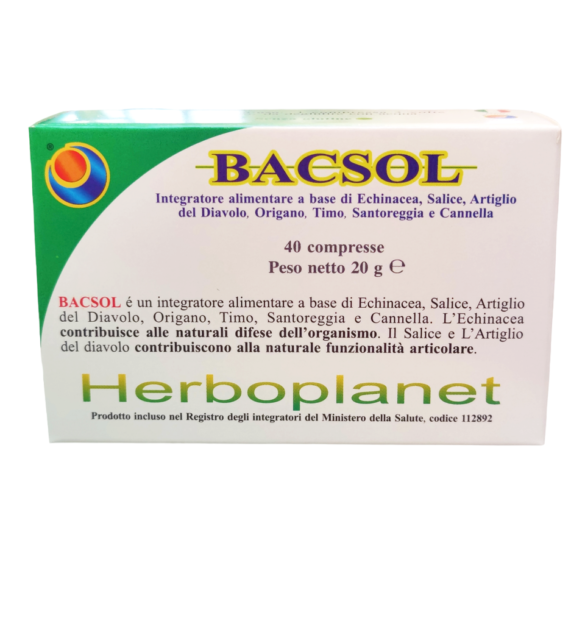
Product included in the register of supplements of the Italian Ministry of Health, code 112891.
INTAKE OF HERBAL INGREDIENTS FOR 2 TABLETS: Bulking agent: microcrystalline cellulose. Olmaria summit (Filipendula ulmaria Max.) dry extract standardised to contain 0.2% salicylic acid 160 mg (contribution in Salicylic acid 320 μg), Devil’s claw root (Harpagophytum procumbens DC.) dry extract standardised to contain 20% Harpagoside 150 mg (contribution in harpagoside 30 mg), white willow bark (Salix alba L.) dry extract titrated to 30% in Salicin 80 mg (contribution in Salicin 24 mg), Nettle leaves (Urtica dioica L.) dry extract titrated at 0.4% in Betasitosterols 80 mg (contribution in Betasitosterols 320 μg). carboxylmethylcellulose. Anti-caking agents: silicon dioxide, magnesium salts of fatty acids.
GLUTEN FREE – FRIEND OF VEGANS
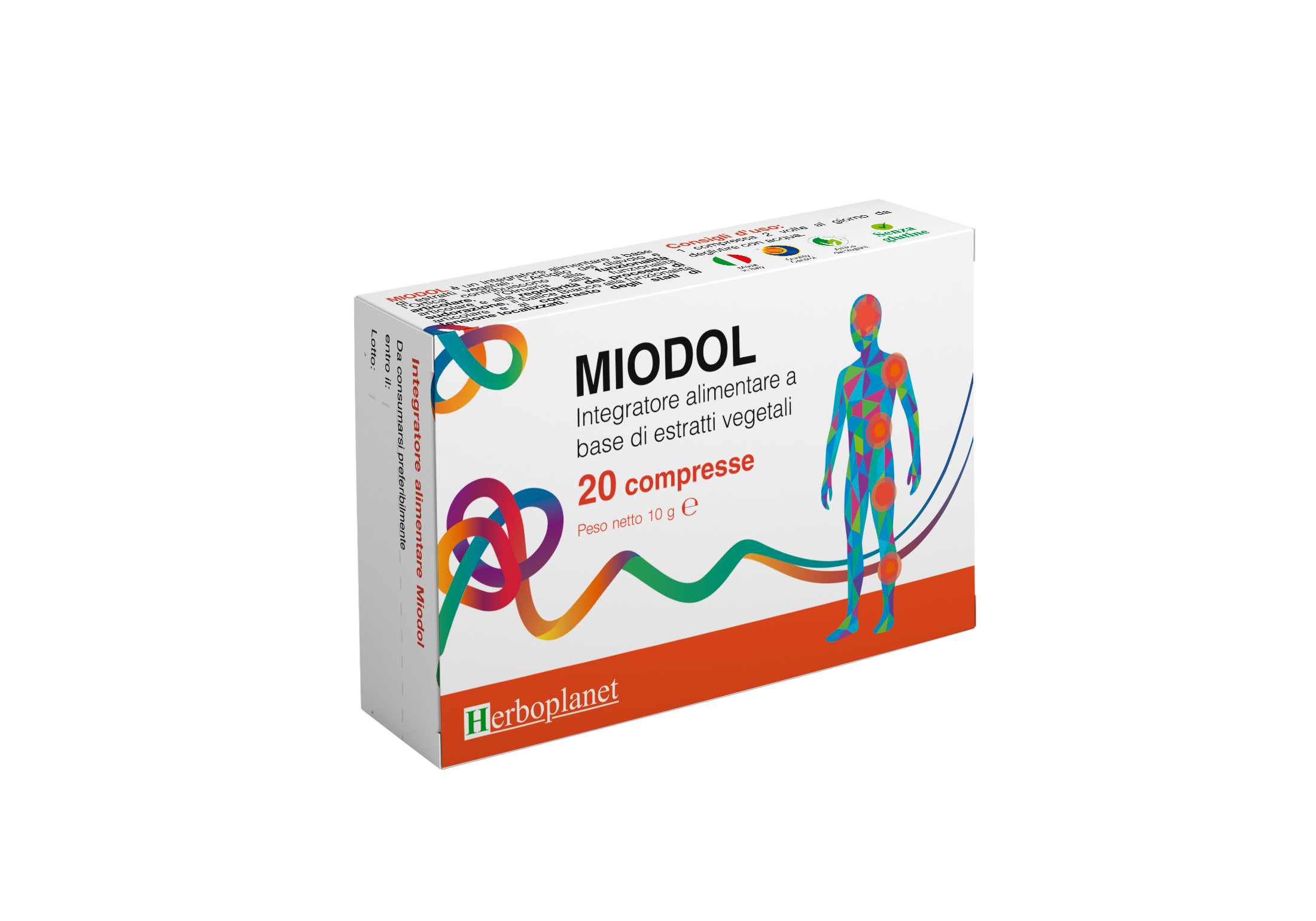
MIODOL is a food supplement based on plant extracts.
DEVIL’S CLAW and NETTLE contribute to joint function.
OLMARIA contributes to joint function and the regularity of the sweating process.
WHITE WILLOW contributes to joint function and to the contrast of localized states of tension.
DIRECTIONS FOR USE: 1 tablet 2 times a day, to be swallowed with water.
WARNINGS: Keep out of the reach of children under three years of age. Do not exceed the recommended daily dose. The product should be used as part of a varied and balanced diet and a healthy lifestyle. If you are taking antiplatelet or anticoagulant drugs, it is advisable to seek the opinion of your doctor. It is not recommended for use by children and adolescents. The use of the product is not recommended in case of presumed or confirmed allergy to one of its components.
Available in the best pharmacies, parapharmacies, herbalists.
[content_control roles=”webinar”]
Pathology:
Rheumatic pain, arthrosis, arthritis, low back pain, myalgia, sciatica, muscle-tension headache, toothache. Fever. Pubalgia. Menstrual pain. Painkiller.
Notes:
DEVIL’s CLAW (Harpagophytum procumbens) has anti-rheumatic (fights uric acid formation) and blood purifying properties. It contains a glucoiridoid that has analgesic properties comparable to those of synthetic anti-inflammatories without possessing its antiarthritic and spasmolytic action. The action of Beta-sitosterol, the principle contained in the root of the plant, is to inhibit the prostaglandin synthetase which participates in the genesis of the inflammatory process. It is believed that the iridoids exert an inhibitory influence on the synthesis of prostaglandins and interfere in the permeability of the cell membrane to ions (Van Hellemont J., op. cit., page 191). The percentage of iridoids, in order to have maximum effectiveness, must not be less than two percent. The first pharmacological works, published in 1958, are due to Professor Zorn, of the Friedrich-Schiller Institute of Hyena and concern the anti-arthritic action of the root of the plant. The plant is native to the Kalahari desert (Africa) and was introduced in Europe in 1953 by O. Volk. We report a potential interaction with anticoagulant drugs such as warfarin, possible bleeding, [Heck A.M. et al., Potential interactions between alternative therapies and warfarin, Am. J. Health Syst. Pharm. 57, 1221-1227 (2000)]). The WILLOW (Salix alba) contains, in the bark of the young branches, salicin, which is a glucoside and which through the enzymatic action of the emulsin, acids, etc. is divided into glucose and saligenin. A noi interessa, come principio attivo, la saligenina che a sua volta nel nostro organismo si trasforma in derivati salicilici come l’acido salicilico, la salicina, ecc.,i quali hanno una forte azione antipiretica, antireumatica, antidolorifica, antispasmotica ed antinfiammatoria, caratteristica dei derivati salicilici, come l’aspirina. Salicylic acid is an inhibitor of prostaglandin synthesis by inactivation of cyclooxygenase. It has an inhibitory action on platelet aggregation. Piria discovered salicylic acid by oxidation of salicin. A recent double-blind study versus placebo evaluated the effect of Salix alba extract in 78 patients suffering from hip and knee osteoarthritis. After two weeks the patients were improved and presented a significant decrease in the pain component (Bruneton, Phytotherapie ….). As far as possible interactions are concerned, it is believed that “the risks are real when the salicylates exceed the dose of 3 grams per day” (Firenzuoli F., 2001). OLMARIA (Spirea ulmaria) has among its principles acetylsalicylic acid which gives it a strong pain-relieving property. It contains a strongly aromatic glucoside called gaultherina which, under the action of the enzyme gaultherase, splits into glucose and methyl salicylate. This active principle makes the drug a good effective diuretic against rheumatoid and gouty excesses, above all when it is necessary to eliminate articular and ascites serous collections. The plant is used in feverish and flu states, as an analgesic in headaches and odontalgia, in acute rheumatic forms and in minor painful articular manifestations. Leclerc advised it in acute rheumatic forms where it would determine a copious diuresis with consequent facilitation of the disappearance of joint effusions. In folk medicine the plant is used in the form of an infusion and used in flu syndromes. The literature does not report secondary and toxic effects at therapeutic doses. Recent studies have shown the presence in NETTLE (Urtica dioica) of glycolic acid, glycerol, sodium, potassium and magnesium salts which would have a diuretic action that would favor the elimination of chlorides and urea, thus increasing urinary purification and the elimination of waste in the blood. For this reason the nettle would be indicated in arthritis and articular and muscular rheumatism. The anti-inflammatory action of the plant has been demonstrated by numerous laboratory studies. In the ESCOP and Commission E monographs, nettle leaves are useful, due to their antiphlogistic action, as adjuvants in the treatment of rheumatic diseases. A clinical trial (non-randomised) showed thatThe intake of the plant is able to reduce the dosage of a non-steroidal anti-inflammatory drug in patients with chronic arthritis, the study showed that 50 mg per day of diclofenac with the addition of 50 grams per day of cooked leaves of Urtica dioica in the diet are as effective as 200 mg per day of diclofenac in decreasing serum levels of C-reactive protein and in controlling acute attacks of arthritis (Monti L.).
COMPLEMENTARY REMEDIESI: ARTROSOL, IALURASE PLUS, SULFONIL, DEFENSOL, BACSOL, HS 214 VITIS COMP.
[/content_control]