Product included in the register of supplements of the Italian Ministry of Health, code 114753.
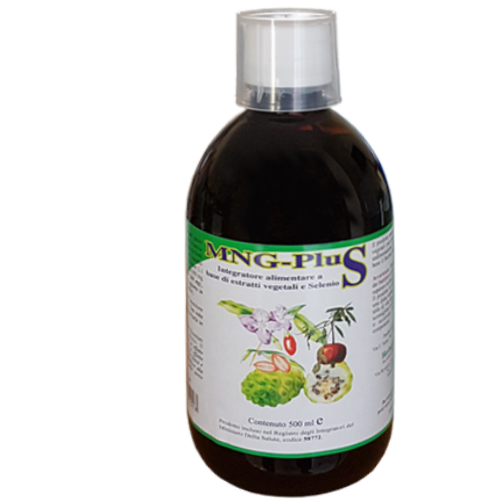
INTAKE OF INGREDIENTS PER 20 ml: Pomegranate juice (Punica granatum L.) 12 ml, pure Noni juice (Morinda citrifolia L.) 8 ml, dry extract of Goji fruits (Lycium barbarum L.) standardised to contain 50 % polysaccharides 600 mg (polysaccharide intake 300 mg). Acidifier: citric acid. Preservative: potassium sorbate. L-Selenomethionine 15 mg (Selenium intake 70 μg = 127.28% NRV*). Preservative: sodium benzoate.
MNG-PLUS is a dietary supplement of plant extracts and selenium.
POMEGRANATE and GOJI have an antioxidant effect.
NONI has a tonic effect in case of physical and mental fatigue.
SELENIUM contributes to the protection of cells from oxidative stress.
RECOMMENDED USE: it is recommended to take 10 ml 2 times a day. Once opened, store it in the refrigerator.
WARNINGS: Keep out of the reach of children under three years of age. Do not exceed the recommended daily dose. The product should be used as part of a varied and balanced diet and a healthy lifestyle.
Available in the best pharmacies, parapharmacies, herbalists.
[content_control roles=”webinar”]
Pathology
Senescence,lack of libido and pleasure, chronic fatigue syndrome, psycho-physical asthenia, depression, stress, sleep disorders, difficulty concentrating, infectious diseases, mononucleosis, arthritis, degenerative diseases, free radicals, arteriosclerosis, herpes labialis, arterial hypertension, intestinal disorders, digestive problems, diabetes 1 and 2, intestinal parasitosis, constipation, obesity, boils, smoking, drug addiction.
Notes
NOTES: the POMEGRANATE (Punica granatum), of Persian origin, was already used in antiquity, as well documented in both art and literature. It is one of the first cultivated fruits of which we have knowledge. From the pomegranate plant, not only the fruit is used but also the peel and root which can be used for various medicinal purposes. Infatti, nella medicina tradizionale cinese, fin dai tempi antichi, il melograno era considerato uno dei rimedi per l’infertilità nelle donne. It can be used in infections caused by tapeworms and dysentery (Caceres A, Giron LM, Alvarado SR, Torres MF. Screening of antimicrobial activity of plants popularly used in Guatemala for treatment of dermatomucosal diseases. J Ethnopharmacol 1987;20:223-237). It is also commonly used in the treatment of some chronic states of the lower and upper limbs Promising results have been achieved in the treatment of some types of cancer and other similar diseases. Above all, pomegranate is considered one of the best fruits available in the fight against diseases generally due to its high levels of vitamins, minerals and antioxidants (this plant is found to be a powerful antioxidant, superior to red wine and equal or better than green tea). The astringent properties of its fruit have been used to treat various problems (wounds, sore throats, gingivitis and periodontitis). Pomegranate is an excellent source of vitamin C: it provides 10-20% of the recommended daily requirement (RDA). The powerful antioxidant properties of its fruit have been attributed to its high content of soluble polyphenols (Gil MI, Tomas-Barberan FA, Hess-Pierce B, et al. Antioxidant activity of pomegranate juice and its relationship with phenolic composition and processing. J Agric Food Chem 2000;48:4581-4589). In vitro tests on normal and cancerous cell colonies of the colon have shown that its juice has a strong antiproliferative and antioxidant power, as well as proapoptitic effects (reduction of plasma concentration) greater than the individual purified active ingredients: this is probably the result of a synergistic action between the compounds contained in the fruit. Research shows its juice can be cardio protective (Sumner MD, Elliott-Eller M, Weidner G, et al. Effects of pomegranate juice consumption on myocardial perfusion in patients with coronary heart disease. Am J Cardiol 2005;96:810-814), may reduce risk factors (such as cholesterol accumulation, so-called “foaming cells” in macrophages, and low-density oxidized lipoproteins [LDL]) without affecting the original LDL. Some studies on the anticarcinogenic effects of this fruit, performed on a culture of the mammary organ of the mouse and in human breast cancer cells (in vitro), have shown that its extract (PFE) is chemopreventive. In another study performed in immunosuppressed (athymic) rats, researchers at the University of Wisconsin, Madison, found that PFE significantly reduced serous levels of prostate-specific antigen and inhibited the proliferation of aggressive cancer cells ( Lansky EP, Jiang W, Mo H, et al. Possible synergistic prostate cancer suppression by anatomically discrete pomegranate fractions. Invest New Drugs 2005;23:11-20 and Lansky EP, Harrison G, Froom P, Jiang WG. Pomegranate pure chemicals show possible synergistic inhibition of human PC-3 prostate cancer cell invasion across Matrigel. Invest New Drugs 2005;23:121-122). Pomegranate extract has shown an antiproliferative, antiestrogenic and proapoptotic action on leukemia cells (Mertens-Talcott SU, Percival SS. Ellagic acid and quercetin interact synergistically with resveratrol in the induction of apoptosis and cause transient cell cycle arrest in human leukemia cells. Cancer Lett 2005;218:141-151) as well as on cancer cells of the breast and prostate. The results of studies conducted on diabetic patients showed that dietary supplementation based on pomegranate juice gave beneficial antioxidant effects on macrophages: this implies that there could be a reduction in the development of arteriosclerosis (Aviram M, Volkova N, Coleman R, et al. Pomegranate phenolics from the peels, arils, and flowers are antiatherogenic: studies in vivo in atherosclerotic apolipoprotein E-deficient (E°) mice and in vitro cultured macrophages and lipoproteins. J Agric Food Chem 2008;56:1148-1157); Pomegranate flower extract appears to reduce the following factors in type 2 diabetic patients with increased fibrosis due to heart failure: hyperglycemia, hyperlipidemia, heart fat (Rosenblat M, Hayek T, 69. Aviram M. Anti-oxidative effects of pomegranate juice (PJ) consumption by diabetic patients on serum and on macrophages. Atherosclerosis 2006;187:363-371). Other research has shown the beneficial effects of pomegranate in promoting neurological well-being, maintaining joint integrity and function, exhibiting estrogenic properties, blocking the spread of herpes simplex virus, triggering immune-protective functions, treating dental diseases , improve the effect of antibiotics used to treat methicillin-resistant and methicillin-sensitive Staphylococcus aureus infections, and prevent smooth muscle dysfunction and fibrosis in erectile dysfunction. In Ayurvedic medicine, the stringent properties of pomegranate are linked to the growth of bones and cartilage and in the cosmetic field, it has been shown that the extract of the peel of the fruit stimulates the production of a type of procollagen and inhibits the processes of degeneration of the dermisThe remedy that can guarantee us from the effects of the aging process has not yet been discovered, no one has ever discovered the road that leads to immortality, but it is certainly possible to slow down the aging process considerably, it is almost unbelievable how many years can be added to the life of each of us, years and years of healthy and happy life. Dr. Heinicke, biochemist, discovered that the fruit of the Hawaiian NONI (Morinda citrifolia) contains an alkaloid precursor of a vital compound called xeronine, precursor of xeronine is proxeronine, this alkaloid is also contained in pineapple, but the fruit of Noni contains it to a greater extent than 800 times. The body produces xeronine to activate enzymes and make them work properly, many diseases develop due to enzymatic malfunction. Without xeronine life would cease, il frutto della Morinda citrifolia, contenendo la proxeronina ha la possibilità di aumentare i livelli di xeronina dando un notevole contributo alla salute ed alla protezione delle cellule. Proxeronine initiates the release of xeronine in the intestinal tract after coming into contact with a specific enzyme also contained in the fruit. This combination is thought to positively affect cellular function. The possibility of obtaining a precursor for xeronine from Noni means that the body naturally decides how much of this precursor it should transform into xeronine. Illness, stress, anger, trauma and injury can decrease levels of xeronine in the body, thereby creating a deficit. Noni is probably the best source of proxeronine known today. Some authors argue that Noni juice would give better results than freeze-dried powder or dry extract. Studies support Noni’s ability to act as an immunostimulant, inhibit the growth of certain tumors, increase and normalize cell function, and increase tissue regeneration. It is considered a powerful blood purifier and contributes to overall homeostasis. Dr. Heinicke believes that the active ingredients contained in the fruit intervene in the repair of damaged cells at a molecular level. The proxeronine contained in Noni increases the production of xeronine , which seems to be able to regulate the shape and integrity of certain proteins that contribute individually to specific cellular activities. According to Dr. Heinicke’s theories, the proxeronine contained in the Hawaiian Noni fruit can be used as an adjuvant in the treatment of various diseases (cancer, senility, arthritis, high and low blood pressure). Anecdotal tests have found that Noni relieves joint pain related to arthritic disease. A link to arthritic pain could be the inability to digest proteins properly or completely, which would lead to the formation of crystalline deposits in the joints. The ability of Hawaiian Noni fruit to increase protein digestion through intense enzymatic function can help eliminate this phenomenon, furthermore, the antioxidant effect of Noni can help decrease the damage caused by free radicals in joint cells, which they can exacerbate despondency and degeneration. The active ingredients present in Noni have been shown to effectively control, or suppress, more than six types of infectious bacterial strains: Escherichia coli, Salmonella typhi (and other types), Shigella paradysenteriae, Staphylococcus aureus. v Epstein-Barr virus, responsible for mononucleosis, which, in turn, is one of the causes of chronic fatigue syndrome. Anecdotal reports support this action, which is that noni seems particularly effective at shortening the duration of certain types of infections. The active ingredients traced in the fruit testify to the possibility they have of stimulating the production of xeronina and could explain the Immunostimulant properties. The alkaloids present are designed to stimulate phagocytosis, a process in which certain leukocytes (macrophages) attack and literally digest infectious organisms. The antitumor action has been attributed to a response of the immune system, which is involved in the stimulation of T cells. The presence of proxeronine in Noni promotes the increase of xeronine in the intestinal tract, allowing the intestinal walls to better absorb various nutrients, especially amino acids. Xeronine makes it possible for larger molecules to pass through cell membranes, resulting in improved digestion. The fruit contains a lot of vitamin C and it is considered a tonic; advisable in the most debilitating conditions. The aging process bombards the body with free radicals that can cause a myriad of degenerative diseases. Dr. Heinicke argues that as we age we lose the ability to synthesize xeronine, this is made worse by the presence of many toxins in the environment, which have the ability to block the production of xeronine. He also argues that the proxeronine contained in Hawaiian Noni would help stop these actions, acting as an anti-senescent substance. Morinda Citrifolia contains selenium, one of the best antioxidant components available today. Noni also acts on a psychic level as xeronine, activated by the proxeronine contained in the fruit, transforms some brain proteins into active endorphin receptors or “feel-good hormone“. Useful for smoking and drug addictions. Noni juice provides proxeronine to the body, the body regulates its assimilation using the amount useful to maintain a good level, the rest is eliminated, so the risk of taking an excessive dose by drinking Noni juice can be excluded. Noni is one of the most important research centres of the beginning of the third millennium. Over the next 15 years, increasingly specific pharmaceutical applications should result. Noni is one of the great research hopes of the twenty-first century. The word “GOJI” is an approximation of the pronunciation of gǒuqǐ (枸杞), its name in several Chinese dialects, it is commercially referred to (in English) goji berry. In addition, Wolf berry, is the common English name for the fruit of two closely related species: Lycium barbarum and Lycium chinense: Solanaceae family that also includes potatoes, tomatoes and tobacco. It is native to southeastern Europe and Asia (northern China, Tibet, and the Himalayas). Goji species are perennials that grow up to 3 meters. L. chinense grows in southern China and tends to be somewhat lower, while L. barbarum grows in the north and tends to be a bit taller. In the northern hemisphere, its flowering occurs from June to September and the ripening of the berries from August to October, depending on the latitude, altitude and climate. These species produce a bright red-orange berry and ellipsoidal and 1-2 cm long berries. In particular, in China as in Tibet, its berries have been believed to be a fountain of youth for 1500 years and traditional Asian medicine has celebrated Goji berries for several centuries as a rebalancing fruit that helps us maintain a state of well-being . This plant grows above all in the areas watered by the Yellow River which fertilizes the soil in a natural way through a yellow mineral powder which is present in its waters. That’s why no type of fertilizer or chemical additives are used to make the taste of this fruit so sweet. Since the early 21st century there has been increasing attention to Goji due to its nutritional value and antioxidant content. The list of benefits of Goji is huge: it is one of the strongest antioxidants in nature; it helps the immune system by stimulating it to purify the skin and producing a tonic-energizing action in the body. It helps improve eyesight and promotes healing. Through its Antioxidant agents, Goji protects DNA and reduces cardiovascular and metabolic disease risks. Due to its natural content of zinc, it stimulates the production of testosterone, thus improving the production of sperm and libido. It helps bones and muscles and the proliferation of spleen cells. In Chinese medicine, it is used to stop diarrhea and as a remedy for dry cough. In relation to the diseases connected to diabetic states, Goji is used to reduce the levels of glucose and cholesterol in the blood. Goji berries contain more vitamin C than even citrus fruits. Vitamins C are also essential antioxidants that reduce the percentage of harmful free radicals from the blood, such as molondialdehyde, which in turn prevents free radicals that induce fatigue and aging. One feature of the goji berry that has recently captured the interest of researchers is its effect on the reduction of hypertrophic and cancerous cells (Mendell, PhD., Earl.”Goji and Cancer”. The Goji Cure. 5 Mar 2009). The chemical component that gives this plant such a beneficial effect is betasitosterol (also called cincolo). This compound was found precisely in these same red berries and the betasitosterol can effectively reduce the diameter of grown cells; and in fact, it can also induce the so-called in the cell apoptosis (cell suicide) of the tumor cell (in the Goji berry there is also Germanium, a particular mineral considered a great ally in the fight against cancer). This property makes it one of the most commonly used treatments for prostate enlargement. After the man has passed the age of 40, for completely physiological reasons the cells of the prostate gland increase their size to a certain extent. When this enlargement persists, a condition called benign prostatic hyperplasia (BPH) can develop. If left free to grow, the gland can cause the urinary tract to become blocked, making it difficult to urinate and, in some cases, causing pain. In the case of prostate cancer, cells expand and divide out of control causing damage to the normal cellular tissue around them. This can create further damage to the normal functioning of the body. Since the Betasitosterol contained in goji significantly reduces the size of these swollen cells without any collateral damage, it is becoming quite popular among doctors (“Complete Beta sitosterol Information“. Drugs.com. 2009. 5 Mar 2009). Goji is also used as a preventive treatment and, in cancer patients, can also be used for a long time alongside other medicines to help reduce cancer cells (no interaction with known medicines has been documented for betasitosterol). Goji berries are rich in vitamin A and B, potassium and polysaccharides. Betaine and the essential fatty acids it contains help detoxify the liver, which is why it is also called “the fruit of life.” In accordance with what results from the test “ORAC” (standard protocol of the US Department of Agriculture able to measure the detoxifying power of foods), Black grapes contain 5,000 ORAC units of oxidizing power, theorange 750 and Goji well 30,000: 600% more than black grape juice. In addition, 15 grams of dried berries cover the entire daily requirement (RDA) of antioxidant substances. Selenium is an antioxidant mineral, able to counteract the harmful action of free radicals. It helps maintain tissue elasticity, delaying the oxidation of polyunsaturated fatty acids, which, in turn, can cause tissue proteins to solidify. The dottor Harman è riuscito a prolungare la vita media degli animali da laboratorio somministrando antiossidanti e la validità dei suoi risultati è stata confermata da molte ricerche successive. Passwater e Welker (American laboratory, May 1971) state that Antioxidant therapy, alone, should add 5 to 10 years to our life. Radiation protection (due to cosmic rays, sunlight and the splitting of the various elements) It should add 2 to 5 years. If we consider how radiation induces aging, we are again faced with the free radicals that result from the process itself.
[/content_control]