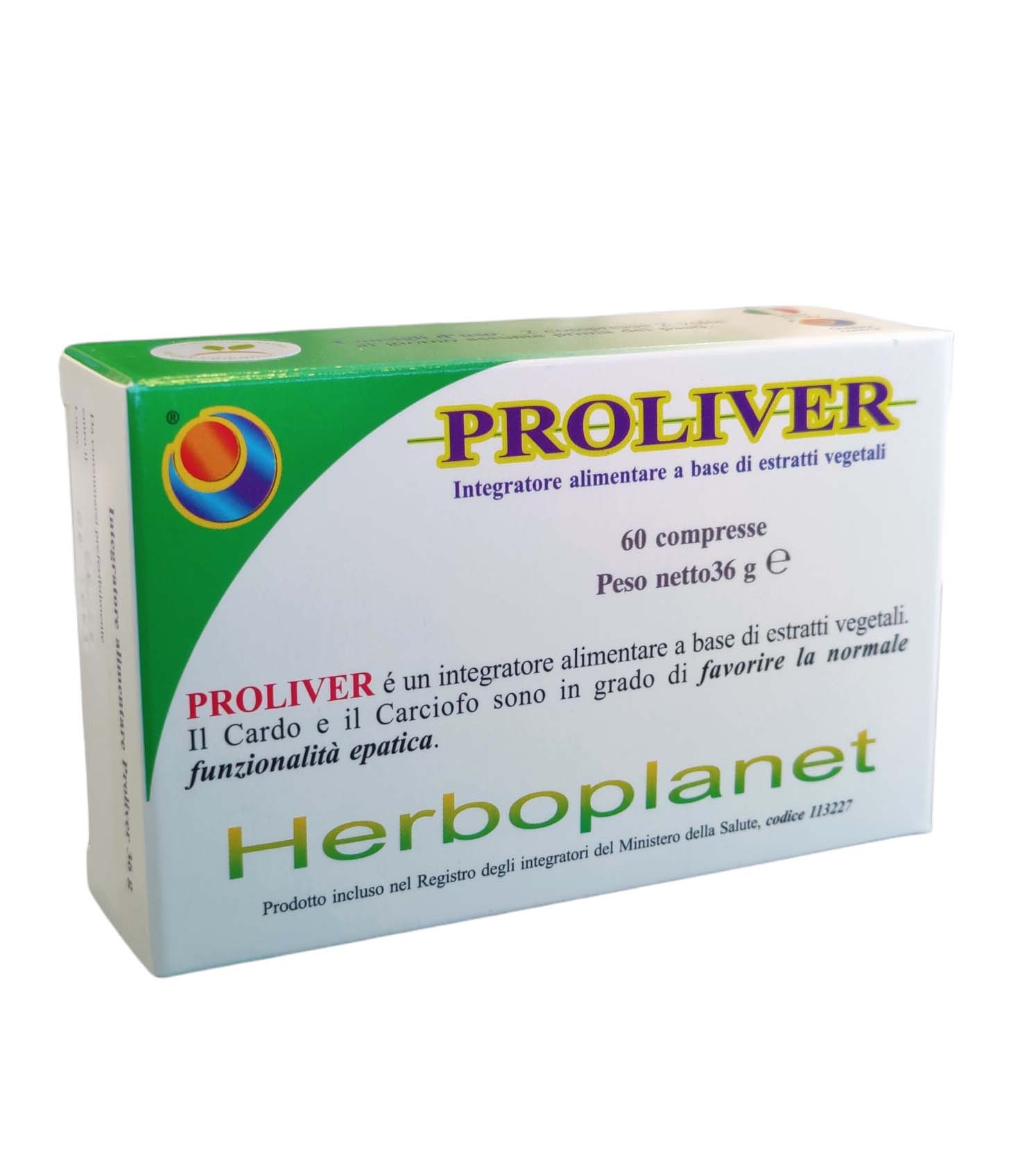
Product included in the register of supplements of the Italian Ministry of Health, code 113227.
HERBAL INGREDIENTS INTAKE FOR 4 TABLETS: Milk thistle fruits dry extract (Silybum marianum Gaertn.) standardised to contain 80% Silymarin 1440 mg (Silymarin 1152 mg, equal to 288 mg per tablet). Bulking agents: microcrystalline cellulose, tribasic calcium phosphate. Artichoke leaves dry extract (Cynara scolymus L.) standardised to contain 2.5% chlorogenic acid 160 mg (contribution in chlorogenic acid 4 mg). Anti-caking agents: magnesium salts of fatty acids, silicon dioxide.
GLUTEN FREE – FRIEND OF VEGANS
PROLIVER is a food supplement based on plant extracts.
CARDO is able to promote normal liver function.
ARTICHOKE contributes to the body’s purifying functions and lipid metabolism.
DIRECTIONS FOR USE: 2 tablets 2 times a day taken before meals.
WARNINGS: Keep out of the reach of children under three years of age. Do not exceed the recommended daily dose. The product should be used as part of a varied and balanced diet and a healthy lifestyle.
Available in the best pharmacies, parapharmacies, herbalists.
[content_control roles=”webinar”]
Pathology:
Hepatic steatosis, liver cirrhosis, hepatitis, jaundice, intoxications, free radicals, hyperhomocysteinemia.
Notes:
The MILK THISTLE (Silybum marianum) once enjoyed much esteem in folk medicine, an esteem that has gradually faded unjustifiably. The plant, in fact, is rich in therapeutic virtues that make it particularly valuable in liver dysfunction. The fruits of the milk thistle, improperly called seeds, contain an active ingredient called silymarin which has a hepatotropic activity and it is for this reason that the thistle enters various formulations of products that boast this action. Silymarin corresponds to the set of three substances called stereoisomers (Silybin, Silydianin and Silycristin). Among the three stereoisomers, Silybin is the most active. Milk Thistle has been at the center of numerous experimental works which demonstrate the anti-hepatotoxic activity of the flavolignans (bioflavonoids) present among the active principles (Silymarin, Silydianin and Silicristin), only recently isolated. However, it is the term silymarin that classifies flavolignans, the primary group of active chemical isomers of milk thistle. These molecules had never been found before in nature (they seem to derive from the union of a molecule of taxifollin with one of coniferyl alcohol) and have demonstrated a very marked hepatoprotective action against toxicants such as carbon tetrachloride, galactosamine, alcohol and the toxins of Amanita phalloid (phalloidin), miraculously, Silymarin, binds to liver cells, preventing the poisons of the mushroom from binding to it, therefore blocking their poisonous effect. Silymarin is also able to neutralize the poison directly, which makes it effective even if taken after the poison of the mushroom has been ingested. Milk thistle extract, for this reason, is kept on hand in German hospitals where it is administered in emergencies to treat Amanita phalloid poisonings. Silymarin and its main isomer, Silybinin, have also been shown to possess antioxidant properties thus preventing lipid oxidation and the destruction of membranes in cells. Laboratory tests and clinical trials have, in fact, proved that Silymarin has an effect on the cell membrane of the hepatocyte by preventing or making it very difficult for various toxic substances to penetrate the liver (membranotropic activity), thus hindering fatty degeneration and cell necrosis. It has also been shown to lead to an increase in protein synthesis in hepatocytes which results in the acceleration of the regeneration process of liver cells, Silymarin increases the activity of polymerase A, stimulates ribonucleic acid and promotes the synthesis intracellular. Silymarin is eliminated to a small extent through the kidneys, while the majority, concentrated in the liver cells, is eliminated through the bile. The fruits of the milk thistle have a regenerative action on the liver, in fact, it accelerates the regeneration process of the liver parenchyma, because the synthesis of RNA is increased by stimulating the activity of the RNA polymerase. Silymarin, on lysosomal and mitochondrial lesions caused by ethanol, is able to intervene positively by restoring them to their normal structure and stimulating the protein synthesis which is also compromised in alcohol-induced lesions. Saba P. and collaborators, in their text “Hepatology” believe that in viral hepatitis Silymarin acts by limiting, through the protection of the hepatocyte membranes, the attachment of the viral agent to the cellular receptors located externally to the cytoplasmic membranes, in doing so, therefore, Silymarin would reduce the number of parasitic hepatocytes and therefore the damage parenchymal and transaminase levels. Milk thistle is a particularly valid agent in the phytotherapeutic treatment of hepatitis, it favors the regeneration of the liver cell and ensures a gentle choleresis and a stimulation of the organic defenses. Since Silymarin is non-toxic, 20 g/kg of weight are perfectly tolerated. In most cases, Silymarin produces a net improvement of subjective and objective symptoms within one or two weeks of treatment (increase in appetite, weight, disappearance of asthenia, digestive disorders, decrease in liver volume, etc. .). The improvements are even more important considering chronically ill patients such as long-time alcoholics. In the presence of Silymarin, tissues use less glutathione (an enzyme that reduces oxidation), this results from a lower decrease of glutathione in red blood cells. Glutathione reduces free radical activity, not just in the liver, but throughout the body. Glutathione (l-glutathione) is a tripeptide (combination of three amino acids, cysteine, glutamic acid and glycine) and it is the most powerful and important of the antioxidants produced by the body, fightsaging through 2 main ways: the intestine and the circulatory system, it protects the cells, tissues and organs of the body managing to keep it young. Glutathione is an organic compound whose deficiency in red blood cells (congenital or acquired during life, due to vaccinations, taking medicines, drugs, alcohol, unsuitable diet, etc.) determines premature aging (cellular, systemic and organic) due to an anomalous oxidative metabolism, which determines the failure to eliminate and therefore the accumulation in the body of toxic substances; its main function is to act as a donor of (negative) electrons in the reaction catalyzed by glutathione peroxidase; this reaction plays a prominent role in the elimination of toxins and in particular of hydrogen peroxide (hydrogen peroxide, loaded with ions +), extremely toxic for cells and always present in the case of medium and serious diseases. With all that the liver has to filter every day, it’s no surprise that it can be overloaded at times. Milk thistle can help rejuvenate the liver and also protect it from future damage. Anyone who has had hepatitis, cirrhosis or other liver dysfunction should add milk thistle as a health component, in fact, it wouldn’t hurt if you habitually take it as a tonic herb, for preventive or maintenance purposes, in the measure of 200 mg of Silymarin per day, after lunch. Silymarin is today not only the best documented substance for liver therapy, but also one of the most thoroughly researched and studied plant extracts with known mechanisms of action. Milk thistle is a liver tonic and rejuvenator, helps in problems and enlarged liver: liver disease from alcoholism, drug use, chronic hepatitis, cirrhosis of the liver, jaundice, sensitivity to chemicals, exposure to industrial toxins, detox programs . Protects the liver from toxic poisoning by toadstools. Regenerates liver tissue damaged by hepatitis, cirrhosis, alcoholism, drugs, and environmental toxins. It also helps against fatigue and food allergies. There are several documents sent for inspection to medical and ministerial commissions to take note of the importance of using glutathione in the treatment of various diseases, including cancer and AIDS. Glutathione also has a great detoxifying capacity thanks to its ability to chelate (chelation = ability of one element to bind to another) heavy and toxic metals such as lead, cadmium, mercury and aluminum and transport them away by eliminating them from the body. Silybin, a component of Silymarin, which is found in Milk Thistle, stimulates the activity of an enzyme, Super Oxide Dismutase (SOD), which acts as a scavenger of free radicals, much more powerful than Vitamin E. Milk Thistle inhibits the lipoxigenase enzyme by preventing the formation of leukotrienes, components responsible for inflammation. The ARTICHOKE (Cynara scolymus) is a biliary flow regulator and a hepatoprotector and is useful in hepatobiliary disorders where it can relieve symptoms; decreases the production of cholesterol and triglycerides. Thanks to the hepatoprotective action, there is also a decrease in blood urea nitrogen. The hepatoprotective and choleretic action of the Artichoke is carried out through its activity on the metabolism of urea, in fact, the Artichoke helps to decrease blood urea nitrogen, stimulating the hepatic transformation of nitrogenous molecules imperfectly elaborated by the insufficient liver, poorly diffusible by the kidney, into urea less toxic and diffusible through the kidney (Nicoletti M., Mazzanti G., Lesson notes, As. Si. Pro Far., 163-164). The artichoke has cholagogue, choleretic and liver function regulator, detoxifying and diuretic properties.
COMPLEMENTARY REMEDIES: BETAMIX, HS 204 CYNARA COMP., EPASOL, IMMUNOSOL, FIBROUP
[/content_control]