Product included in the register of supplements of the Italian Ministry of Health, code 112851.
CONTRIBUTION OF HERBAL COMPONENTS PER 100 DROPS: Hydroalcoholic solutions R.E. 1/5 of: Milk thistle (Silybum marianum Gaertn.) seeds 875 mg, Artichoke (Cynara scolymus L.) leaves 875 mg, Dandelion (Taraxacum officinale Weber) root 595 mg, Rhubarb (Rheum palmatum L.) rhizome 595 mg, Chicory (Cichorium intybus L.) top and root 350 mg, Horehound (Marrubium vulgare L.) flowering plant 152.6 mg. Essential oils of: Mint (Mentha x piperita L.) 16.45 mg, Rosemary (Rosmarinus officinali L.) 16.45 mg. Zinc gluconate 24.5 mg (Zinc intake 3.43 mg = 34.3% NRV).
GLUTEN FREE – FRIEND OF VEGANS
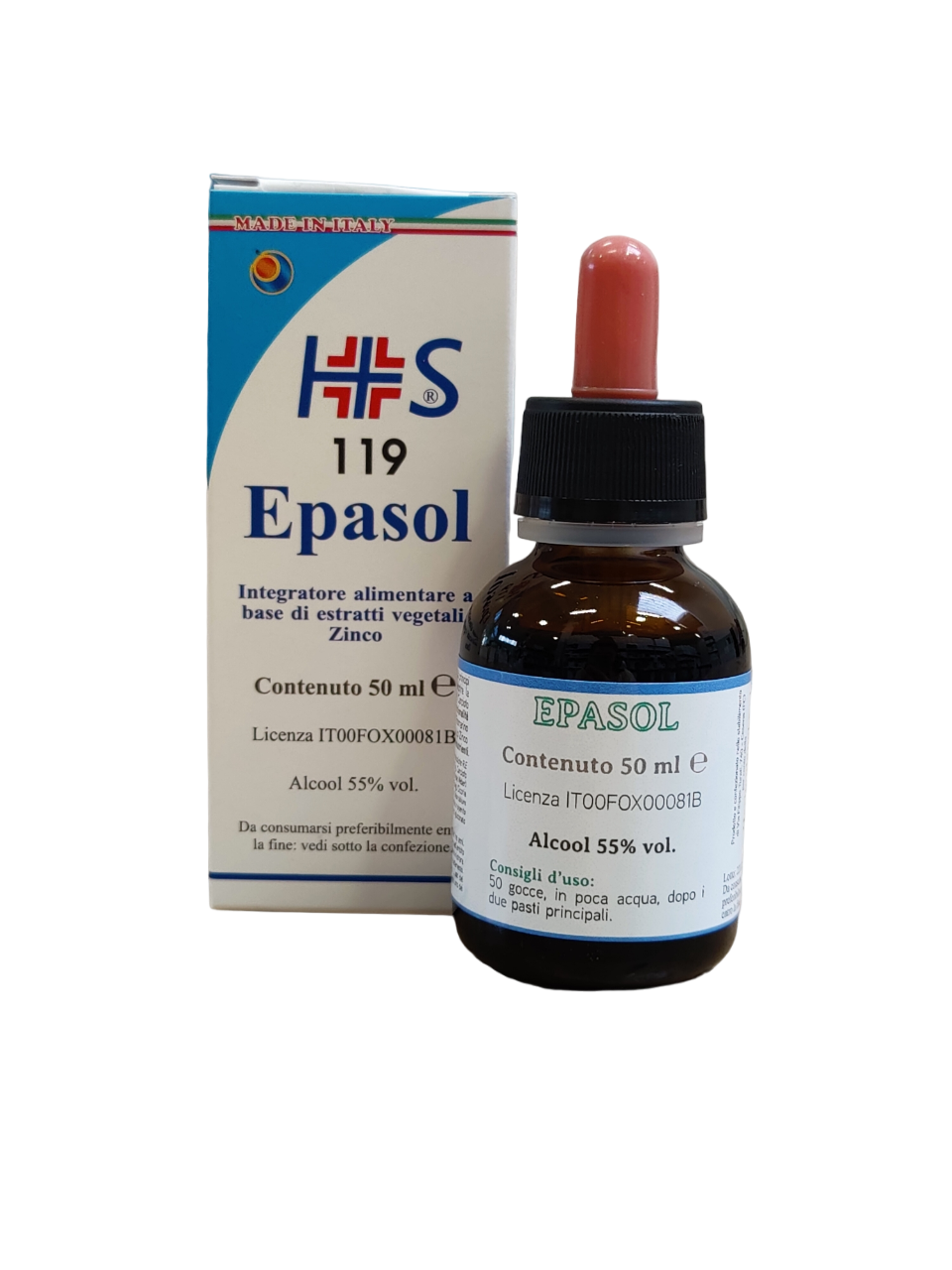
EPASOL is a supplement based on vegetable principles and Zinc.
CHICORY is useful for promoting digestive and hepatobiliary function.
CARDO promotes liver function.
DANDELION contributes to the regularity of intestinal transit
ARTICHOKE is useful for the elimination of intestinal gas.
RHUBARB, HOREHOUND, and ROSEMARY are useful for promoting digestive function.
MINT contributes to regular gastrointestinal motility.
ZINC contributes to the normal metabolism of macronutrients.
DIRECTIONS FOR USE: 50 drops, in a little water, after the two main meals.
WARNINGS Keep out of the reach of children under three years of age. Do not exceed the recommended daily dose. The product should be used as part of a varied and balanced diet and a healthy lifestyle. Do not administer to children under 12 years of age. Consult your doctor if you are pregnant or breastfeeding. Do not use for prolonged periods without consulting your doctor.
Available in the best pharmacies, parapharmacies, herbalists.
[content_control roles=”webinar”]
Pathology:
Hepatic emunctory activator, regulates gallbladder motility, antispasmodic (also in cholelithiasis). Acute and chronic hepatitis, hypertriglyceridemia, digestive, biliary dyskinesias. Excellent bile thinner.
Notes:
CARDO (Silybum marianum) is indicated in the prophylaxis and therapy of liver diseases due to intoxication (toxins, alcohol), it is a hepatoprotector. It has been tested in intoxications with compounds that induce the degeneration of hepatocytes. The flavonolignans contained in thistle bind to the cell membrane stimulating the production of RNA by acting on RNA-polymerase A, so that as a consequence there is an increased enzymatic synthesis with consequent facilitation of the detoxification of harmful molecules. Furthermore, the binding of flavonolignans reduces the entry of compounds into the cell cytoplasm. The thistle also contains other active ingredients, such as flavonoids and sterols, which promote the biliary and renal elimination of toxic metabolites and reduce the deposit of fat in the liver parenchyma. Excellent cholagogue, depurative, tonic and stimulating digestion. Main remedy as hepatoprotector in intoxications by hepatotoxic substances, useful in liver failure (cirrhosis, hepatitis, etc.), also useful as a cholecystokinetic. ARTICHOKE (Cynara scolymus) is a stimulant of liver and biliary functions thanks to its contained principles (caffeilquinic acid and flavonoids). The increase in the metabolic activity of the hepatobiliary enzymatic chains causes a reduction in cholesterolemia and in nitrogen and lipid levels. Flavonoids and terpene alcohols protect the membrane of the liver parenchyma. It has a digestive, purifying action, useful in hepatobiliary dysfunctions (with or without lithiasis), in hypercholesterolemia and hyperuricemia related to hepatopathies of various entities, hyperlipidemia and in atheromatous risk. In DANDELION (Taraxacum officinale) the triterpenes (taraxasterols), in synergy with the sesquiterpenic lactones, act as cholecystokinetics by activating the muscles of the gallbladder by modifying the chemical-physical characteristics of the bile. Flavonoids and eudesmanolides interact by increasing diuresis. It has a protective action against free radicals. Useful as a draining and purifying hepatorenal, in disorders of the gallbladder and in biliary lithiasis, in dermatoses associated with dysmetabolism. RHUBARB (Rheum officinale) has cholagogue, laxative and tonic and stomachic properties in small doses. Due to its property of evacuating bile it is also used in liver diseases. CHICORY (Cichorium intybus) contains lactucin (bitter principle), chicory (a glucoside), an oil (similar to coffee caffeol), stearic and acetic acid, inulin, mucilage and mineral salts (calcium, iron, potassium). Chicory with the principles contained in it stimulates the functions of the intestine, liver and kidneys, being highly purifying and detoxifying. Thanks to the inulin it contains, it lowers the percentage of glucose in the blood of diabetics. The horehound (Marrubium vulgare) contains marrubin (0.3 – 1%), gallic acid, mucilage, pectins, flavonoids, alkaloids, betonicin, mineral salts and ethereal oil that give the plant special tonic, digestive, antiseptic, antispasmodic and expectorant properties. This plant improves the functioning of the stomach. The diterpenic and depsidic fractions contained in ROSEMARY (Rosmarinus officinalis) and rosmarinic acid perform numerous activities: cholecystokinetic, at the gastrointestinal level there is the stimulation of the digestive functions and the regularization of the activity of the bacterial flora. Useful in dyspepsia with flatulence especially if connected with hepatobiliary stasis, digestive headaches. MINT (Mentha x piperita) contains flavonoids that have spasmolytic and choleretic action (the latter function is due to the furan and ketone fractions of the essential oil). Rosmarinic acid is an antioxidant and reduces the release of free radicals in the liver parenchyma. Peppermint essential oil has eupeptic, carminative and anti-inflammatory properties. Useful as a gastrointestinal spasmolytic, eupeptic, carminative, cholecystokinetic and antispasmodic (also in cholelithiasis), useful in digestive headaches. ZINC is important for the welfare of animals and humans, the liver cells contain the highest value, from 200 to 390 milligrams per kilogram of dry weight, next comes the pancreas, then the sexual glands and the endocrine glands. The role of Zinc in the synthesis of certain enzymes is known, the lack of Zinc can only lead to disturbances in the metabolism or cellular exchanges. At the level of the pancreas, Zinc stimulates the Islets of Langerhans for the processing of insulin. Zinc deficiency causes an imbalance in this secretion, consequently, an imbalance in the metabolism of carbohydrates with the consequent increase in blood glucose. There is a close relationship between the insulin content of the pancreas and the insulin-secreting Islets of Langerhans. Zinc and insulin form an insoluble combination which becomes soluble in the body in the presence of blood glucose. It is therefore necessary to ensure the coverage of zinc to avoid disturbances of the activity of the Isles of Langerhans. Spagyric zinc is a hepatic tropism component and simultaneously normalizing for pituitary functions. In the Alchemical Tradition zinc is associated with Jupiter. Jupiter is the archetype that in the Greco-Roman tradition is “King of the Gods”, the one who decides for everyone and administers justice on Olympus. The similarity with pituitary function is evident where hormonal feedback allows the pituitary to control the other glands. Jupiter finds its zodiacal domicile in the sign of Sagittarius which energetically corresponds to the liver. Jupiter in the liver rules the autonomic nervous system and the pituitary gland.
COMPLEMENTARY REMEDIES: PROLIVER, BETAMIX, ENZYSOL, EPATOSOL, HS 204 CYNARA COMP.
[/content_control]